Heart Beat: The Dingbat Font That Adds a Pulse of Love to Your Designs
There's something magical about a design that feels alive. You know the kind—it catches your eye, holds your attention, and makes you feel something before you even read the words. That's the power of typography done right, and it's exactly what the Heart Beat dingbat font brings to the table. This isn't your typical typeface where letters sit quietly on a baseline. Each character in Heart Beat dances to its own rhythm, transforming the humble heartbeat motif into a playful design element that pulses with romance, whimsy, and genuine visual energy.
Whether you're a designer working on a client's brand identity, a small business owner crafting packaging for a new product line, or a content creator looking for that perfect accent to make social media graphics pop, Heart Beat offers something refreshingly different. It's a creative font that fills a niche many designers didn't even know they needed—until they see it in action.
What Makes Heart Beat Visually Distinctive
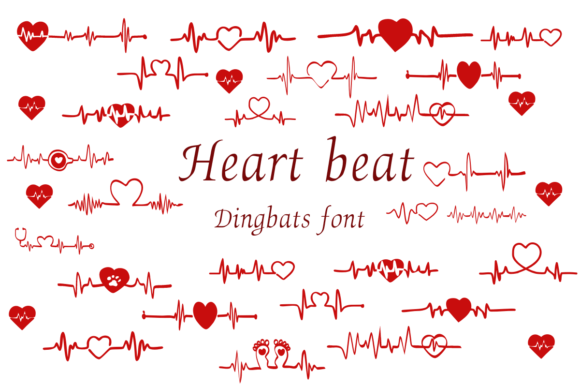
Let's be honest: the design world is saturated with script fonts, serif fonts, and sans serif fonts that all start to blur together after a while. Heart Beat sidesteps that fatigue entirely. As a dingbat font, it doesn't deliver traditional letterforms. Instead, each keystroke produces a unique heart-shaped beat illustration, varying in size, tilt, and energy. Some characters feel like a gentle pulse on a monitor. Others look like they're mid-bounce, full of excitement and motion.
This variation is what gives Heart Beat its personality. When you string several characters together, you don't get a repetitive row of identical hearts. You get a rhythm—a visual cadence that mirrors the irregular, organic feel of an actual heartbeat. That quality alone makes it a standout design asset for projects where you want to convey warmth, affection, celebration, or playfulness without relying on stock illustrations or clip art.
The linework is clean and modern, which means it pairs surprisingly well with a wide range of typography styles. Use it alongside a bold display font for contrast, or nestle it next to a handwritten font for a cohesive, crafty aesthetic. The versatility here is genuinely impressive for a specialty typeface.
Real-World Applications Across Industries
The beauty of a font like Heart Beat is that it isn't limited to Valentine's Day cards or wedding invitations—though it absolutely excels in those contexts. Its applications stretch far wider than you might initially expect.
Branding and Logo Design: For businesses in the wellness, beauty, dating, healthcare, or lifestyle spaces, Heart Beat can serve as a supporting visual element in brand identity systems. Imagine a small skincare company using a single heartbeat character as a favicon, or a couples' therapy practice incorporating it into their logo mark. It adds a human touch that stock geometric shapes simply can't replicate.
Packaging Design: Artisan food brands, candle makers, boutique gift companies—anyone selling products that carry emotional weight—can use Heart Beat to add a subtle flourish to labels, box art, or hang tags. It works especially well when you need a small decorative element that doesn't overwhelm the primary typography.
Social Media Graphics: Content creators and marketers know that stopping the scroll requires visual distinctiveness. Heart Beat characters make excellent accent pieces in Instagram stories, Pinterest pins, Facebook headers, and TikTok overlays. They're eye-catching without being cluttered, and they communicate emotion instantly—something that matters when you have less than a second to grab attention.
Web Design and Blogs: Website dividers, section breaks, bullet replacements, newsletter headers—there are dozens of subtle ways to integrate a dingbat font into digital layouts. Heart Beat can add personality to an otherwise minimal website design, giving blogs and landing pages a warmer, more approachable feel.
Print Materials and Editorial Layouts: From magazine pull quotes to poster accents, from invitation suites to thank-you cards, Heart Beat brings editorial design to life. It's particularly effective in projects where you want to create visual hierarchy without adding another text-heavy element.
Merchandise and Digital Products: T-shirt designers, sticker creators, and print-on-demand entrepreneurs can incorporate Heart Beat into product designs for Valentine's collections, anniversary merchandise, or year-round love-themed product lines. Because it's a font rather than a raster image, it scales cleanly at any size—critical for merchandise that ranges from small stickers to large posters.
Pairing Heart Beat With Other Typography
One of the most practical questions designers face with any specialty font is how it plays with others. Heart Beat's clean, illustrative style makes it a surprisingly flexible teammate in font pairing scenarios.
For a modern, polished look, try combining Heart Beat with a geometric sans serif font. The contrast between the organic heart shapes and the structured letterforms creates visual interest without clashing. If your project leans more romantic or handmade, pair it with a flowing script font or a textured handwritten font—the shared warmth between the styles creates a cohesive mood.
For editorial or publishing work, Heart Beat can sit alongside a classic serif font as a decorative accent. Think of it as the visual equivalent of a pull quote or a decorative initial cap—it draws the eye and breaks up long blocks of text without disrupting readability.
A few practical tips for font pairing with Heart Beat:
- Use it sparingly as an accent, not as body text replacement.
- Match its scale carefully—too large and it overwhelms; too small and its charm gets lost.
- Consider the weight of your primary typeface. A heavy display font balanced with delicate Heart Beat characters can look stunning.
- Test pairings at the actual size they'll appear in your final design, whether that's a business card or a billboard.
Readability, Licensing, and Professional Considerations
Because Heart Beat is a dingbat font rather than a text typeface, readability in the traditional sense doesn't apply the way it would with a serif or sans serif font. However, that doesn't mean you can ignore how it functions in context. The hearts need to be clearly visible and recognizable at whatever size you're using them. Test your designs at multiple scales and on different screens or print outputs to make sure the detail holds up.
It's also worth reviewing what font styles and weights are included in your Heart Beat package. Some premium fonts come with multiple variations—filled, outlined, or stylistic alternates—that give you more creative flexibility. Understanding what's available upfront saves time during the design process and ensures you're getting full value from your purchase.
Commercial licensing is another area worth attention, especially if you're a business owner, freelancer, or agency designer. Before using Heart Beat in client work, merchandise, or digital products for sale, verify that your license covers commercial use. Most reputable font foundries and marketplaces are transparent about licensing terms, but it's always smart to double-check. Using a creative font in a commercial project without the proper license can lead to legal headaches nobody wants.
Adding Emotional Resonance to Visual Communication
At its core, design is about communication. Every color, shape, and typeface choice sends a message—sometimes consciously, sometimes not. What Heart Beat does exceptionally well is inject emotional resonance into a project with minimal effort. A single heartbeat character in a newsletter header can make a brand feel more human. A row of them dancing across a product label can turn a simple package into something that feels celebratory.
For designers and creators who understand that modern typography is as much about feeling as it is about function, Heart Beat is a tool worth exploring. It won't replace your primary typeface, and it shouldn't. But as a supporting player in your design toolkit—a creative font that adds warmth, rhythm, and personality—it fills a role that few other design assets can match.
The next time you're working on a project that needs a little more heart—literally—give Heart Beat a try. You might be surprised at how much life a few playful beats can bring to your work.